
Learning Design FAQ
1. What is our learning design approach?
LanguageMate's design draws on several well-established strands of language acquisition and learning research:
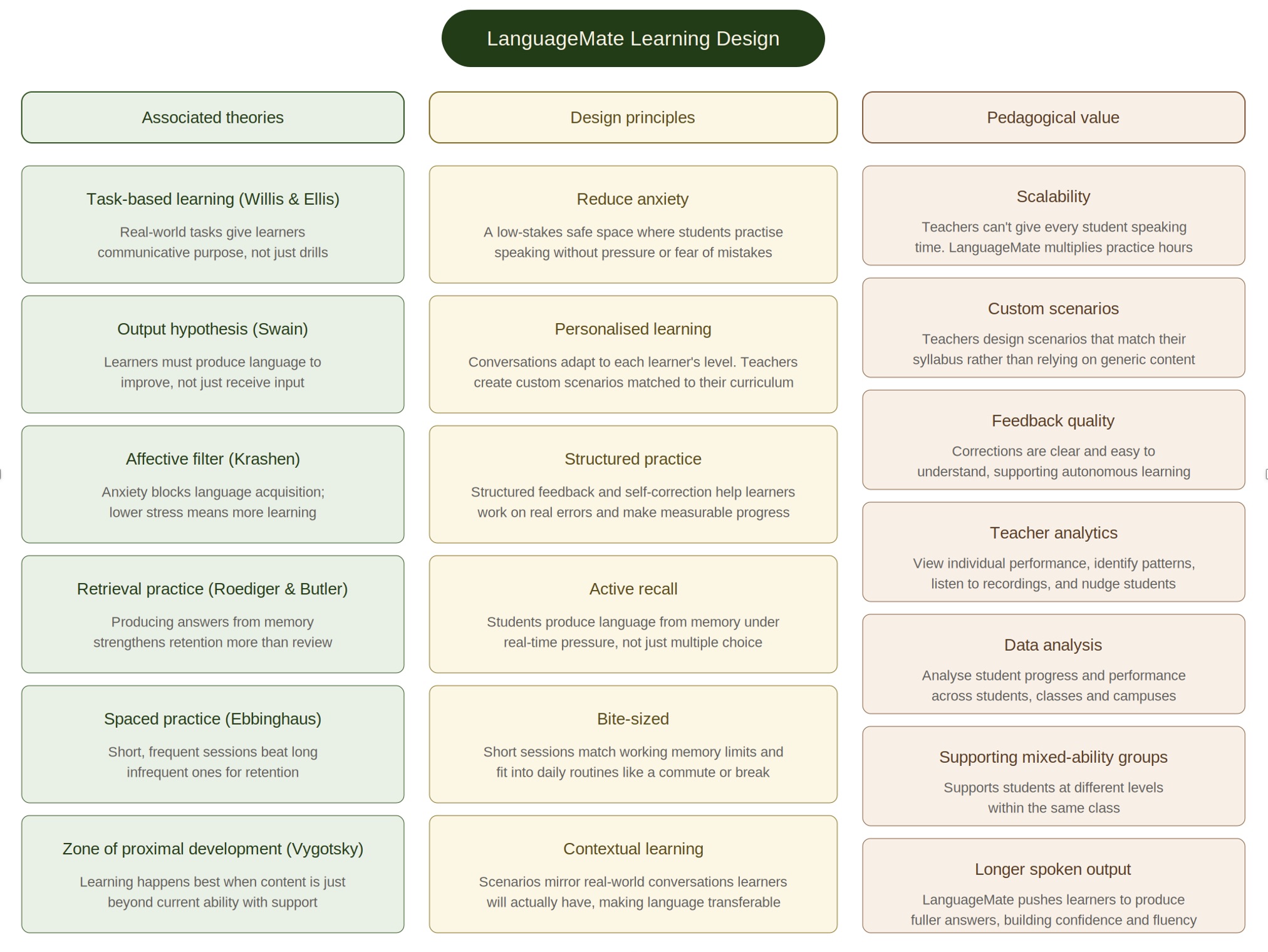
2. What is the pedagogical value of LanguageMate?
LanguageMate addresses one of the most persistent problems in language education: students rarely get enough speaking practice. Even in immersive environments, opportunities to practise spoken production in a structured, supported way are limited outside the classroom. LanguageMate provides a scalable solution by offering interactive, scenario-based speaking activities that students can use independently, with clear corrective feedback and detailed analytics for teachers.
Key pillars of our pedagogical value
- Scalability: A single teacher cannot give every student meaningful speaking time in a class. LanguageMate multiplies practice opportunities without requiring additional teacher hours.
- Curriculum alignment and custom scenarios: Teachers can design scenarios that match what they are actually teaching, rather than relying on generic content.
- Actionable feedback: Corrections are clear, easy to understand, and presented visually, making the platform valuable for autonomous learning.
- Teacher and admin analytics: Teachers and administrators can view students' performance, identify patterns in learner difficulties, and pinpoint areas requiring focus, all in one place. This depth of analysis is uncommon in speaking tools.
- Lower-anxiety practice environment: Many students who will not speak in class will speak to LanguageMate, removing one of the biggest barriers to speaking development.
3. What is the learning design of LanguageMate?
LanguageMate was built around foundational principles, supported by our practical design mechanics that make those principles work in practice.
Foundational principles
- Task-based learning. Activities are built around meaningful tasks and real-world scenarios rather than isolated drills. Learners practise language with a communicative purpose, which reflects how language is actually used outside the classroom and supports transfer of skills into real situations.
- Reducing anxiety around spoken practice. Many language learners experience anxiety when speaking, which inhibits participation and progress. LanguageMate creates a lower-stakes environment where students can practise without the pressure of a classroom or the fear of making mistakes in front of peers.
- Personalisation. Rather than offering a fixed sequence of generic content, the platform adapts to each student. Conversations respond to learner input in real time, and teachers can create custom scenarios aligned to their specific curriculum, which means that practice remains relevant, targeted, and directly connected to each learner's goals and course of study.
- Rewarding genuine progress over gamification. The platform deliberately avoids gamified points and superficial reward systems. This is because it is not designed to maximise engagement through artificially engineered dopamine responses, but to support genuine linguistic development. Instead, the focus is on structured feedback, self-correction, and measurable improvement in actual spoken output.
Practical design mechanics
- Active recall. Students produce language from memory, not just recognise or select it. Active recall is one of the most well-evidenced learning strategies across all domains, and it is particularly important for speaking, where learners need to retrieve vocabulary and grammar under real-time pressure.
- Bite-sized lessons. Sessions are deliberately designed to be short, matching the limits of short-term memory and allowing for regular, consistent study. Frequent short sessions are more effective for language retention than infrequent long ones.
- Contextual learning that mirrors real conversations. Scenarios are not abstract grammar drills. They simulate real communicative situations learners are likely to encounter, making the language immediately relevant and transferable.
4. Why does LanguageMate use a conversation stage followed by a review stage?
The separation is deliberate and pedagogically motivated as explained below.
Why not correct during the conversation?
Constant interruptions and real-time corrections act as distractions and can knock student confidence. Because one of LanguageMate's core principles is to create a lower-anxiety environment for practice, students need space to get on with their speaking without being interrupted. Too much in-the-moment correction risks students stopping speaking altogether, which is the very thing the platform exists to prevent.
While teachers can, and often do, make notes while listening, this is not the same as what LanguageMate provides. The platform captures and retains all errors, offering immediate, clear explanations and corrections that appear without disrupting the flow of conversation.
Why have a review stage?
The review stage creates a structured space for learners to reflect on their output, notice errors, and work on corrections systematically. This separation also aligns with the distinction between fluency-focused and accuracy-focused practice: the conversation stage builds fluency and confidence, while the review stage builds accuracy and awareness.
It also supports the active recall principle. When students revisit their own output and work through corrections, they are engaging in another layer of retrieval and reinforcement, which strengthens learning.
The review stage can be optional, and teachers retain full control over when to require it, allowing them to adapt its use to suit their learners and teaching context.
5. Why use LanguageMate instead of other language apps?
LanguageMate occupies a different category from standard consumer language apps. We provide a scalable tool for educators and learners.
Key differentiators
- Focus on active skills, particularly speaking. Many language learning tools cover a range of skills, including reading, listening, and writing, as well as systems such as vocabulary and grammar. LanguageMate is designed with a clear focus on active skill development, especially spoken production, which is often less developed in other platforms.
- Integration of systems within speaking practice. Rather than isolating vocabulary, grammar, pronunciation, and discourse, LanguageMate brings these systems together within meaningful speaking tasks, helping learners apply what they know in context.
- Teacher analytics and class management. LanguageMate provides teachers with detailed insight into student performance, including access to recordings, progress tracking, and the ability to guide learners. This supports more informed teaching and targeted intervention.
- Custom, curriculum-aligned content. Teachers can create and adapt scenarios that reflect their syllabus and learner needs, allowing speaking practice to sit directly within an existing course rather than alongside it.
- Structured feedback to support accuracy. The platform is designed to deliver clear, timely feedback and opportunities for reflection, supporting the development of accuracy alongside fluency. It is designed to be a serious educational tool that prioritises learning over simple engagement mechanics.
Improvement over engagement
Most language apps are designed to keep users engaged. LanguageMate is designed to make learners better at speaking. It is a teaching tool that integrates into a curriculum, not a standalone consumer product. It enables scalable, personalised speaking practice while supporting teachers to deliver more effective learning at scale.